
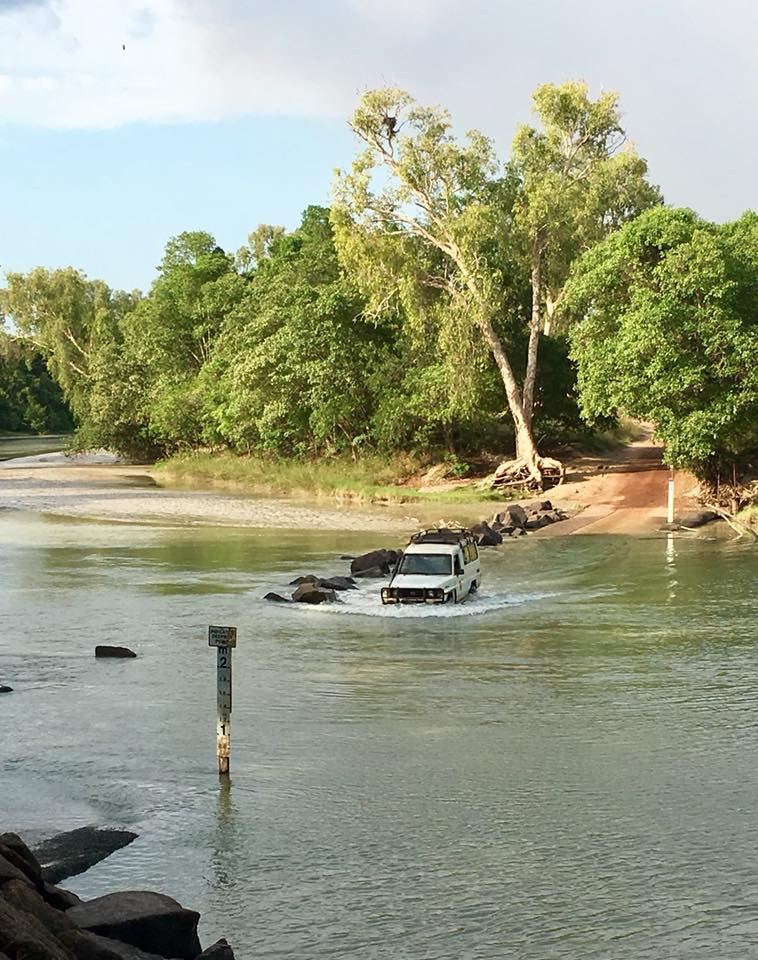
The Northern Territory is crocodile country and Darwin is its capital. Most activities here revolve around crocs. If you aren’t croc spotting or learning about their habitats and behaviors at a croc breeding center, you’ still be thinking about crocs. If you are fishing, swimming, hiking, or boating, you will also be avoiding crocs. If you are driving, you’ll observe that road hazard signs share real estate with croc safety warnings. If you park your car, you’re likely to see safety warnings about crocs there too. And if you are chatting up locals, you will hear gruesome tales of tourists who failed to take those cautions seriously.
Resting on the banks of the East Alligator River
At our first check-in, we learned of a fisherman and his wife who were cleaning their catch at the riverbank. She turned to put the fish in their cooler and in the blink of an eye her husband was dragged off by a croc never to be seen again. At our next lodge, we were cautioned to be careful as we boarded our rental boat. The previous year, a brazen young man decided to swim the river, only to be dismembered and eaten by a 15-foot monster. At the next reception desk, we learned a 13-footer was swimming near the beach the prior week and had to be hauled off to a breeding farm. Only a year earlier, a swimmer on the same beach had been dragged under by a similarly sized croc never to be seen again.
We live in South Carolina. We have our fair share of alligators. However, while there is a fascination with gators, they aren’t the primary attraction for tourists. Apparently alligators and salt water “pebble worms” are not on par. Aptly named by aboriginals, these Australian crocs are extremely dangerous predators and they seem to be everywhere. They have a reputation for being much more aggressive than their Charleston brethren.
Swimming in thecYellow River at break of dawn
It is the Northern Territory ecosystem that contributes to the pervasive danger. The area is laced with rivers that feed into the Timor Sea providing prime breeding grounds for the crocs during the dry season. However, during the wet season, the rivers spill over into huge swathes of wetlands exponentially expanding their habitat. Crocs who find themselves comfortably feeding in smaller creeks and billabongs in the wet season, quickly deplete their food supply in the dry season when their watering holes evaporate. That’s when they start chowing down on people. Masters of disguise, and stealth swimmers, they can surprise attack from land or water. As many as two dozen tourists are snatched by these jaws of death each year. Gladly, we weren’t among the statistics.