We left a day early so we could rest up before starting our adventure in Zimbabwe, Zambia and Botswana. We arrived in Johannesburg, SA, our embarkation point, after 27 hours of travel. Did we rest? Of course not. Headed out on a tour of the Cradle of Humankind (google it), where the largest collection of early human fossils, were discovered 45 meters below the surface in a series of underground limestone caves. We climbed almost 200 steps in both directions, navigated through a network of dark slippery passages and squeezed through openings barely a meter wide and tall. I worried that my hard hat was going to give me hat head, but it saved me from a concussion! Imagine paleontologists chipping 3.7 million year old fossils out of these ancient rock formations put my own feeble attempt to explore my ancestry to shame. Now our real African adventure begins!
When I said travel adventure, I meant it in every sense of the word. After a wake-up call at 5:00 am, we drove 45 minutes to JNB for our flight to Victoria Falls, took a 2 hour plane ride, then boarded a bus, and traveled an hour on a highway that didn't deserve the name. That road turned into an unpaved road and we bounced along for another 2 hours before turning onto the park access road. We drove 45 min through a dirt road used to transport coal mined from an open pit that stretched for miles on either side. Finally we reached the entrance to Hwange National Park, Zimbabwe's largest, where we boarded a safari jeep and bounced over rocky, dirt roads for another hour before arriving at our tented camp. Did I mention it was 106 degrees? The only saving grace was the unexpected sighting of two large elephants outside the park, and the friendly Zambians we met along the way. Zambia has an 80% unemployment rate, a corrupt government that has auctioned off its mineral rights to the highest bidder, and marginal respect for its National Parks. But Hwange's 5000+ square miles of parkland is home to over 45,000 elephants. Can't wait to see what will tomorrow bring?
So here's the down and dirty on safaris! You have to be in the jeeps by 6:30 for any chance to spot animals, because by 11:00 the sun is boiling hot. It reached 106 again. You travel on dirt roads, strewn with rocks and old chunks of concrete, whipping past tree branches, bouncing over ruts caused by other jeeps that passed through when the rains turned the dirt to mud. You strain to see through the greenery in hopes of glimpsing an animal. If you do spot something, you have a few seconds to snap a picture before it disappears in the bush. And god forbid your camera isn’t ready. Most are already done breakfast and napping, so you keep looking. You drive for hours, and maybe you spot a giraffe. Or not. After 2 hours we reached a large lake and finally were rewarded with baboons, hippopotami, crocs and wart hogs. As a reward, tea and cakes were served off the back of the jeep. Then another few hours back to camp in search of more animals. Hot and exhausted, on arrival, you're served lunch, take a nap, and by 4:00 you're doing it again! And somehow, you are loving it all.
This was our opportunity to get up close and personal with local African villagers. We were invited into the home of a local village head, a woman in her fifties with 4 daughters, 5 grandchildren and the responsibility of metering out justice and maintaining peace between all members of her community. Her homestead, much like the others spreading for miles in every direction, defies description. Situated on arid, red clay soil, with nary a tree in sight, the modest cement buildings were used for sleeping or hosting guests. Cooking facilities were outside, and the brick bathroom for the eleven family members living with her, was without doors. Instead there was a privacy wall shielding prying eyes from people squatting over an open hole in the ground. No ventilation, no fan. There was no running water. Bucket showers were the only available way to wash off the heat and dust. Retrieved from a tap 3 miles away, the water was carried on their heads in buckets weighing almost 50 pounds, in the blistering heat. Sometimes, with no shoes. The level of poverty was hard to comprehend…..and yet they were gracious, funny, open and curious. We learned so much during our visit, but the biggest lesson was that wealth is often measured in happiness, not money. We asked them about their dreams. None could imagine abandoning their family or friend for a life outside the village. We, however, couldn't imagine living a single day there.
Another grueling day of travel. The heat is relentless, but our guide has found ways to keep us comfortable. The distances in Africa are vast, the roads poor, facilities few and far between. It was 8 hours before we arrived in Zambia at our camp on the Kafue River. After a celebratory greeting, we were met by a wart hog that has a burrow beneath the reception pavilion and an angry male elephant in search of a mate. He came silently through the bush and stood a few feet away from us before turning and walking toward our jeeps for a taste of the leaves shading them. A night time game drive with plenty of animal sightings followed. The magical experience was celebrated with a gourmet meal topped off with cheesecake!
Our camp is in the middle of Zambia in Kafue National Park, which is the size of New Jersey. It is a free range park with no fencing, and the camp is the same. We require escorts when making way to our tents at night. Once we retire, we cannot leave until the morning wake-up call. We thought this might be overkill, until we heard hippos enjoying a midnight snack behind our tents as we were falling asleep. Later we were awakened by a screaming hyena standing outside our bedroom windows.
Our first excursion was an early morning river cruise down the LaPufa River. The stillness was interrupted by bird calls and chortling hippos who played a game of whack-a-mole as we glided past. Occasionally they sent up a water spot as they snorted. A few hugged the banks, guarding their babies in the shallows, protected by the shade of the overhanging tree branches. Large crocodiles silently drifted by, while wart hogs and pukus grazed on marsh grasses. We scanned constantly for movement, hoping to see elephants or zebras, but only the birds danced for us. And then, just as we had exhausted hope, a leopard emerged from the trees. He crept across a marshy expanse of grass, stopping to crouch and survey the birds feeding on the bank. He continued to pace, stalking the rotting crocodile carcass at the waters edge. For some reason, he changed his mind and retreated, but not before we enjoyed a 10 minute performance by one of the park's most elusive predators.
The day was not over. A sunset game drive provided more animal sightings, a beautiful sunset and a full moon.
And a side note on pictures...most of these pictures were taken at a significant distance. The animals are seldom close, extremely good a camouflage and skittish. I've never had such difficulty getting a good shot...but I'll keep trying!
A game drive is a bit like playing “Where's Waldo?” Out by 6:30, and rumbling along for hours marveling at guides who can spot an animal ¼ mile away hidden in brush or behind a tree while driving at 35 miles an hour. It's pure chance to spot something rare or actually, anything at all.
Nabil decided to skip the morning drive and enjoy the solitude of the pool and river views. I opted to go. We returned 3 hours later, hot, sweaty and exhausted with little to show for our effort.
Nabil, on the other hand, had the opportunity to get up close with two bull elephants who came to check out his music speaker, had an encounter with a wart hog as he did push-ups, encountered monkeys as he walked back to his room, swam with birds in the pool and watched hippos watching him as he sat on to the river bank. That's life…you win some you lose some. Never let FOMO dictate your choices.
Another long day of travel, kicked off by an elephant sighting at the restroom on the airstrip. That never happens in the US! Despite an auspicious start, after our short flight, it was a long overland trip to Botswana. It provided the opportunity to make a few stops in Zambia, in order to get a feel for local life. Our first, was a quick detour to Shoprite…which was surprisingly familiar, modern and clean. A privileged few do enjoy the finer things in life, but it is a small percentage of the population.
That stop was quickly followed up by a visit to the open market. The contrast couldn't have been greater. The squalor and poverty were unimaginable. Many Zambian families survive on a dollar a day. Vendors open up large bags of grain, sugar or laundry detergent and parcel them out in small plastic bags that sell for pennies. Some vendors sell rocks that pregnant women suck on in order to get their minerals. They call it chocolate. Sadly, it’s not. One-a-day is nowhere to be seen here. Mopani worms, which are actually dried caterpillars, are sold in small plastic tubs. So are tiny dried sardines. These are cheap sources of protein for people who can seldom afford meat. It is a bustling, chaotic scene, with children hawking vegetables, and old women bargaining with customers, each claiming to make the better peanut powder, or roasted corn. Nonetheless, their smiles are as bright as the Zambian sun overhead. And all of this is happening in 100 degree heat. Life here is brutal but it goes on and on and on.
Our third stop was at a roadside village where most of the residents worked at the large commercial farms run by British farmers. In comparison to our Zimbabwe village visit, these folks enjoyed a better standard of living but take that with a grain of salt. The two room house we toured was crammed with used furniture and electronics. Shelving climbed up all the walls serving as a whole house pantry. Electric was solar powered. Water came from a central tap mired in mud, just a few yards away. The temperature inside the house was hotter than the outside. It is hard to bear witness to such hardship without feeling both ashamed and grateful.
A few hours later we pulled into our next camp right outside Chobe National Park overlooking an expansive sun drenched plain replete with grazing animals.
It is a awe inspiring location and our first evening game drive didn't disappoint.
Our base camp, Baobab, overlooks the Chobe flat plains, and is outside the National Park. It stretches to the border of Namibia. The park is about 11,000 square miles and is home to 60,000 elephants and perhaps a million impalas.
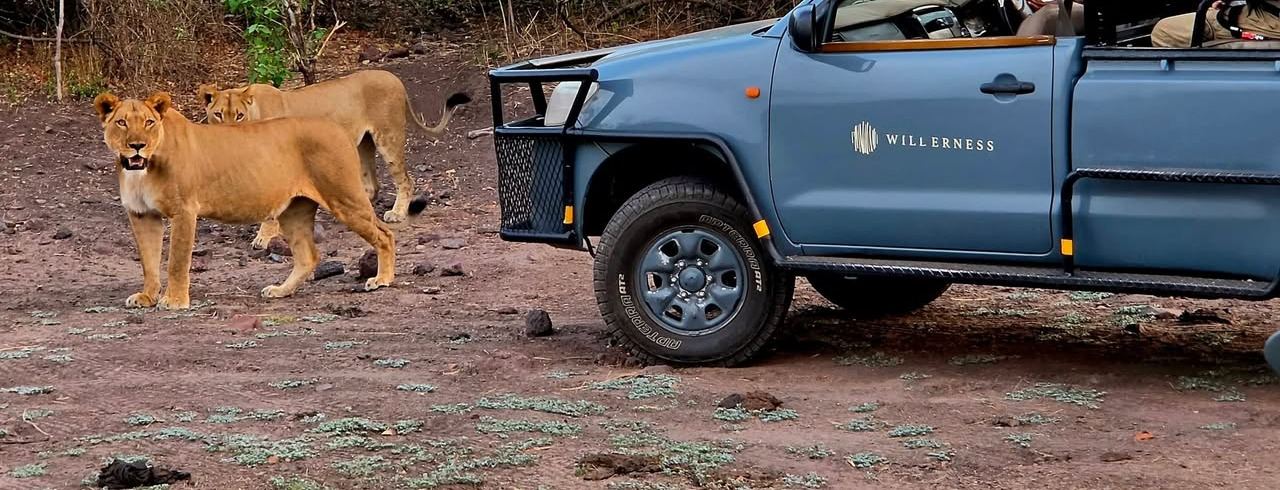
Today, we took a morning and evening game drive. They were both spectacular. Our guides can spot a jackal from almost half a mile away…and they know it’s a jackal, not a fox, or coyote or wild dog. WITHOUT BINOCULARS! It never ceases to amaze me and I love seeing their skills in action. Not only have we seen a variety of animals, we've been able to observe and learn about their behaviors: feeding, hunting, mating, cohabitating, competing and staying cool. Yes, it's still 100 degrees plus! Each drive is an experience, the same, but different, depending on what you see and the time of day. It feels like we are in a washing machine on wheels, as we maneuver on unpaved roads, full of rocks, and ruts created by elephants, hippos and herds of kudu. Two elephants on the flat plains, can look like large boulders. Giraffes, despite their size, can be hard to spot behind a thicket of bare trees. It is a place teeming with life. There is courtship, mating, feasting, predation, competition, sharing, death and disease. It is truly wild, but also so familiar. And when you are parked in an open vehicle 4 feet away from a pride of thirteen lions your heart is pounding, yet your eyes are riveted. THIS IS AFRICA!
Our last day in Chobe, and it did not disappoint. Vultures feasting on a giraffe carcass, lions lounging in the shade, an elephant herd bathing in the river, rare sable and roan antelopes, baboons, crocs, a solitary hippo, impalas, birds, a jackal snacking on a dead impala, zebras, cape buffalo and giraffes, including one doing yoga on the salt flat. Our wonderful guides ferreted out the best viewing sites, found a perfect picnic spot, and brought us safely home. They are the bomb. At the end of the day, we enjoyed a farewell dinner around the campfire and were serenaded by the Baobab staff. It will be hard to leave here.
We departed Chobe with regret and anticipation as we headed to the Okavanga Delta. It is a UNESCO protected bioreserve, where we will be staying in an eco-friendly tented camp on the bank of a small river channel. The temperatures continue to be fierce. We drink as much as two
gallons of water a day. While the distance on a map from one camp to the next is only about 250 miles, it can take 18 hours by car. The roads are not real roads, but groomed animal trails that wind through swamp, scrub brush and forest. So we took a bus to Kasane airport, landed on a remote strip near the Khwai river, board a jeep, drove an hour, took a picnic break, and a 40 minute ride in a mokoro canoe, and then got back in the jeeps for a 2 hour jeep ride to camp. Most of it was within the reserve and we got a small taste of what the next day promised. After a delicious meal, we gathered around a campfire, enjoyed a star-filled sky, and were escorted to our tents where we were zipped in for the night. Thank God, because an elephant, a few hippos and a coyote were camped right outside most of the night!
PS. In the absence of AC, we wet down a towel, lay it over our naked selves and let the fan blow over us. Just as cooling, and you can keep the windows open! With screens of course!
A full day navigating the Okavanga Delta, with a 6:00 am and 4:30 pm game drive. Midday was spent showering between noon and our afternoon departure and laying on wet towels while a fan blew cool air over us. Nothing.moves midday, except for a few birds. It is eerily still, especially knowing that dangerous animals may be under the shade of a tree just yards away. Nonetheless, the Delta is teeming with life at any temperature. Mababe, which is where we are, is more of the same, just a different setting with animals deciding what behavior they want to display. Today, the highlight was a leopard stalking guinea fowl, and a pack of African wild dogs on the hunt…both rare sightings! Not sure who was more excited, the tour group or the guides!
Our last day in Mababe Camp in The Okavanga Delta. It’s hotter than Hades again! Our morning drive took us in a new direction where we crossed the Mababe River. Thick greenery boxed us in on both sides, as we rumbled along on sandy roads that threw up dust clouds. In some places in the Kalahari the sand is thirty meters thick. We were surprised by elephants, including a bull in must, which we had to avoid. We saw several baby impalas leaping in the grass, but they're too fast to capture on film. It's spring here, and plentiful food encourages new babies. We found a pride of 10 lions, 8 of which were yearlings, lounging in a shaded portion of the road. They were totally unfazed by our jeeps, only occasionally rearing their heads to catch a breeze, yawn, or look into the distance. We saw waterbucks, kudus, cape buffalo and wildebeest. It's all becoming routine, as if we've become part of this wild place. But just when you think you've seen it all, you cross a bridge that terrifies you and then a view opens up that takes your breath away. Or an elephant strolls into the river by your camp. Or you see an ostrich taking off through the bush. We witnessed a breeding herd of nearly 100 elephants, from enormous matriarchs to babies just a few weeks old grazing in a field. And just as we had settled in for our last return to camp we saw our first hyena, a mother with three nursing pups. Wild, unexpected, fascinating, poor, yet unbelievably rich, Africa is truly unique. We will miss our game drives, no matter how uncomfortable. And we will miss the hardworking, smiling people who make it all happen. We will leave the heat behind, but they will endure it.
A morning salute from the baboons across the river as the sun came up between the trees. We said goodbye to Mababe at 6:00 am and made the long and very hot trek back to Victoria Falls. I've become accustomed to flying in a Cessna Caravan, which is akin to cramming into a sardine can with wings. Upon arrival we enjoyed lunch at Zulu bistro, where the tasting menu included crocodile tail, goat curry, and other Zimbabwean foods. Not bad, but not my favorite cuisine. Finally settled into our hotel, where air conditioning was a celebrated luxury and a necessity! In the evening, we enjoyed a home-hosted dinner. Our hostess, was a lovely woman who used to work as a safari camp manager, but now stays at home with her 5 year old son, who treated us to his Michael Jackson impression. It was another cultural exchange opportunity that reinforced our appreciation for the hospitality of Zimbabweans. Though she and her husband were university graduates, they were a struggling lower middle class family. There are no loans or mortgages available here, so owning a home or buying a car is nearly impossible. It took her 7 years to save up for her Nissan car. And then the country tacked on a 100% duty tax. Her small home was inherited from her parents, the same one where she and her six siblings grew up. Water and electricity are rationed. But at least they have it. Meat is enjoyed once or twice a month at best. Again, it was an experience that showed us how small the world is because we had more in common with Mpilo and her family than you might imagine. And yet, we enjoy so many more creature comforts. I wonder if they make us any happier than she is. Her smile makes me think not!
Our trip is winding down as the temperature continues to soar. Summers at home are brutal, but air conditioning makes it bearable. Our hotel room here is cooled, but communal areas, shopping malls, and even airports are not. The heat is unrelenting, so our walking tour of Victoria Falls kicked off at 6:00 in the morning. The two mile route winds around the Zimbabwe side of the gorge where the Zambezi River rushes over the basalt cliffs on the opposite side. Several view points punctuate the path. In the rainy season, the falls stretch for almost a mile, but because the rains haven't come yet, there are some dry gaps. The water thunders into the ravine below forming glistening pools of water between the rocks that have tumbled into the gorge. Mist rises like smoke into the cerulean sky, the moisture creating a narrow strip of tropical jungle along the meandering path. Brilliant rainbows split the sky as they arch across gorge. It is breathtaking. By 8:00 am, we were back on the bus returning to the hotel. The afternoon was free, the first real opportunity in almost 2 weeks to wander around, grab a cappuccino and do some shopping. The day ended with a sunset river cruise on the mighty Zambezi, with our final crocodile and hippo sightings, followed by dinner under the stars. A group of baboons in the nearby trees kept us laughing as they descended from their perches, to play on the carks parked across the way. And finally, we got tickets to Simunye, an African cultural show that bedazzled us with energetic dancing, pounding African rhythms, and great costume and set design. If nothing else, travel keeps you on your toes. No rest for the weary!
Our adventure closed out today, but not without a morning lecture about David Livingstone, the first white man to explore the interior of the “Dark Continent”. It was an extraordinary tale of a man obsessed with understanding the geography, plants, animals, and culture of a world vastly different than Victorian England, where he grew up. While our own exploration has been challenging, it doesn't compare to his; traveling by ox cart and foot through an uncharted wilderness where wild animals lived in far greater numbers than they do now. Hostile tribes were wary of white men who were largely associated with the slave trade. His relentless curiosity and passion was responsible for opening up its bounty for the world to exploit its resources and enjoy its bounty.
Soon after our education, we were bundled off to the airport for a grueling 36 hour return home. We've brought with us a renewed respect for travel and the gifts it bestows, an appreciation for the African people, a love of nature, and a fascination with the wild animals that call it home. We learned much on this trip, especially about the importance of taking it slow and living for the moment. To all who have followed our adventure, we hope you have fallen in love with Southern Africa, like we have. " "Re a leboga"