At Dhobi Ghat, in the slums of Mumbai, laundering clothes is an open air enterprise that employs countless day laborers. It's a bustling maze of cement washing pens, rubber hoses and flogging stones, where the dust and grime of the city is scrubbed away by hand, then line dried for pennies an hour. Ever so grateful for my front loading Samsung stackable!
Touchdown in Mumbai, our own gateway to a tour of Southern India...
A grooming assist in the light of early morning. No one showed up to brush my hair though!!!!
Perusing Indian art & artifacts at the Prince of Wales Museum in Mumbai...
This beautiful cave painting date back to around 600 AD..
View from one side of the horseshoe rimmed cave to the other....the temple entrances visible on the hillside..
ELEPHANT CARVING MARKING THE ENTRANCE TO ONE OF AJANTA CAVE TEMPLES
Travel is humbling. It is a reminder that all our beliefs and experiences are the result of where we have sprouted and how far the wind blows us from our roots. We are shaped by time, place and the people, ideas and the experiences we share along the way.
We are born to die, and how we do that is an accident of birth.
But for an embrace between two lovers and a blink in time, your life might be that of anyone alive or dead.
It is our human spirit that binds us, not the beliefs we profess. Let go. Celebrate it all.
Impossible to fathom the scale, artistry and manpower needed to carve this Hindu temple from a singular block of rock. 756 AD. It took over 150 years to complete.
Once the capital city of India when it was under Mughal rule, Daulatabad Fort was the preamble to a later exploration of Ellora Caves
India street life. Open your paint box! @ Ajanta, Maharashtra, India
Fooled you! NOT the Taj Mahal. The grandson of the Shah who built the iconic Taj for his beloved wife, built this mini version (not so mini) as a tomb to honor his mother. Not as fine in materials or workmanship, nor as well maintained....but impressive and beautiful nonetheless. And what mother wouldn't want a son like that? @ Bibi Ka Maqbara
On our way to the Ellora Caves, we made a stop at Daulatabad Fort. Not the main attraction, but impressive nonetheless. That in itself speaks to the wealth of treasures to be discovered in India. Once a summer residence of the ruler who built the Taj Mahal, later a fort, then a capital city, the impenetrable design included a moat filled with crocodiles, vipers and insects, hidden passages, burning oil cauldrons and huge spike laden entrance gates meant to impale elephants carrying enemy marauders. We made it inside without incident! Well, maybe sore feet. @ Daulatabad fort
Words and pictures cannot do justice to the Ellora Cave site, another UNESCO World Heritage Site. First, they are not caves. It is a collection of 34 temples and monasteries built more than 1500 years ago. Buddhist, Hindu and Jain, each was carved from a rock ledge. The most elaborate are Kailasa Temple and cave 32, a Jain temple.
However simple that may sound, the end result defies comprehension. Imagine standing on mountain, and deciding to chisel a four story temple complex complete with pillared galleries, stairs, coffered ceilings, sculptures, towers, elephants and balconies. Imagine doing so with simple hand tools. Then imagine that the craftsmanship would rival that of the most elaborate artworks in ancient or modern times.
Nothing was done piecemeal, or offsite. Everything was conceived and created from a single chunk of earth. As you wander through the dark interior chambers with only filtered sunlight exposing the beauty, you stand in awe of the transformative power of human ingenuity.
Faces of India....
A small museum in Pune housing an interesting private collection of Indian artifacts, including household items, textiles and musical instruments.
Panjim, an old Portuguese enclave in Goa, filled with charming buildings fallen into disrepair and a few that have been repurposed as hotels and shops. The white washed churches stand in stark contrast to the disheveled facades of the rest of the city. But the best was the carved wooden menu box we encountered at the Panjim Inn...great coffee and bebicina. @ Panjim, Goa, India
Yesterday included a visit to an Indian spice farm. We wandered through a half acre of jungle ferreting out pepper vines, cardamom trees, cinnamon trees, clove bushes and cashew nut trees and jungle flowers. It was fascinating to see where and how these precious ingredients are sourced. We also learned about their medicinal applications. A McCormick's tin is only the end of the line.
We topped it all off with 50 proof alcohol made from cashew apples. A sip is all you need for a little zip! @ Cô Á
Goa is a small state (by size) on India's east coast occupied by the Portuguese until 1961. Sixteen million people call it home.
It is renowned for its beaches and in the '60s yoga seekers and hippies came here in droves. Vestiges of old forts stand guard over sandy beaches lapped by the warm waters of the Arabian sea.
Some areas are lovely, others littered with trash. The vibe was supposedly chill back in the day. No longer. The whole coast is packed with tourists and locals. Cows and dogs are frequent guests.
The main tourist draw are two massive 16th century cathedrals built by the Portuguese, which are slowly losing ground to the elements. Panjim is another tourist spot, but its beautiful buildings are sagging under the weight of time.
While we had a lovely time, and one of the best fish dinners of my life, I felt a deep sadness. Poverty, population and pollution are taking a toll. The natural beauty has been marred by the overwhelming task of staying alive. I keep seeing the flaws. But the people who live here see past them. Perhaps that is the real beauty of India.
. @ Aguada Fort, Goa, India
Yesterday, was tough. We made a 7 hour journey by car through the mountains of the Western Ghats and the countryside of the state of Karnataka. The roads were in disrepair much of the way, and often too narrow for two-way traffic. Bucolic farm scenes and mountain vistas were interrupted by dirt encrusted cities and villages scarred by poverty. Life is so hard for the people here. I wondered if our destination was worth the trip.
Then we arrived at the Badami Caves, a complex of temples built in the 6th century by the Chalukya kings who ruled here for 300 years. The 8 temples are built into and on the surrounding hills above a beautiful man made lake, that once served as the city reservoir. Today the scenic lake is used by villagers to wash their clothes.
Yes, it was worth it. This is the first of several monuments to be explored over the next few days...with less driving between them!
This is not an Indian clown car. It's a taxi crammed with as many as 20 people, but licensed for six people. Not air conditioned. Traveling dusty pot-holed roads in 95 degree heat.
Today we toured Pattadakal and Aihole, two temple complexes that were constructed by the same Chalukyan dynasty that built the temples in Badami. Together these three sites represent the capital, the religious center and the learning center of a sophisticated empire dating back 1500 years. They promoted economic justice, sexual equality and religious freedom.
Pattadakal is a UNESCO World Heritage site. Upon arrival, we noticed its similarity to Angkor Wat in Cambodia. It is likely that this royal temple complex, which was used as a coronation site for 98 different kings over 300 years, was also the inspiration for the Cambodians. In fact, it was likely the design source for many other temples in Asia. You can imagine kings and their royal entourage, and guests from other kingdoms arriving by elephant, dressed in the finery displayed in the carvings to celebrate and then returning to their kingdoms with "temple envy".
Just a few kilometers down the road, Aihole, the second complex, was a trade school of sorts. It was where builders experimented in temple design. It was also a training center for artisans and engineers. We saw a small portion of the 120+ temples that dot an area that measures almost 4 square kilometers, learned about the evolution of construction methods and the stories behind the carvings of the Hindu gods. Brain full!
These women are from the Banjara tribe. Their village is very near our hotel, an opulent estate that was once owned by members of the royal dynasties that ruled here. We are living minutes away but worlds apart.
Their ethnic dress and customs are fast disappearing. Jeans and Western style clothes are the preferred dress of their daughters. Cultures are not clashing here. They are colliding with brutal speed. @ Sandur, Karnataka
There's so much to say...see a longer post on Facebook
The Queen of Clorox is having a love affair with one of the dirtiest places on earth. I am not judging. The simple fact is that most of India is living in third world conditions.
On our travels, we have passed village after village made of crumbling masonry, corrugated tin, and plastic sheeting. Deplorable living conditions are the norm, not the exception.
Animals and people slumber under the shade of dusty trees. They rest on dirt. Or dirty plastic crates. There are piles of dirt. Dirty gullies. Dirty streets. Pigs and goats rooting through dirty piles of garbage. Chickens pecking in the dirt. Dirt encrusted vehicles. Dirt stained doorways. What isn't dirty is rusty or in disrepair. It's a clean freak's worst nightmare.
Few homes have running water. You would actually be hard pressed to call them homes. Huts. Shacks. Lean-to's. Hovels. But make no mistake. They are homes. Homes to hundreds of millions of people. Whole families crowding into a room or two scraping out a living amidst the dirt. Communal water spigots serve as gathering places. People wash on the street. Even privacy is a luxury here. Laundry is scrubbed on cement slabs and dried on stacks of firewood. Sometimes it is hung on wire fencing. Dishes are washed in an assortment of plastic tubs spread out in front of doorways. It's not easy being clean here. It is mostly the work of women. It is endless. Somehow they manage.
Despite the hardships, India is fascinating. It is surprisingly energizing. An inspiring entrepreneurial spirit thrives here. Problem solving is a way of life. India is everything my perfectly ordered, antiseptic life full of comforts and sameness is not. I love them both and love them more for being so different from the other.
@ Karnataka Big Bazar
Yesterday we visited two temples in Belur and Halebid, both nearly 1,000 years old, and masterpieces among the 98 temples sponsored by the Hoysala dynasty in Karnataka. The Belur Temple took 103 years to complete, Halebid 198. The latter was destroyed twice by invaders. Still incomplete, it contains 20,000 statues.
More than a thousand workers labored to sculpt Belur's 10,000 statues. A rough estimate is that it took 4.5 million man hours to construct it. The details include such minutiae as a housefly on a jackfruit, and a dog on a leash, a bangle slipping down a wrist, a monkey grabbing at a sari, and layered necklaces that swing with the curve of the dancers' bodies. The renderings tell the fantastical stories of Hindu mythology, depict imaginary monsters, erotica, and symbols of power and prosperity. Much of the work is open filigree. You can slip a finger behind and between the delicate carvings.
The temples are crafted of soapstone, a soft malleable stone in shades of dark grey and black that hardens like metal when exposed to the elements. If you flick your fingers against the turned flanges of the columns, you can hear a metallic twang.
These temple complexes were vital community centers, where weddings were held, rituals performed, meals served and conferences and meetings conducted. They are still active centers of worship. You can rent the marriage hall in Belur for $5!
@ Belur Sri Chennakeshava Temple
Still mourning my lost Mysore photos, but we are in Bangalore now. There's no comparison. This is a modern technology hub bursting at the seams and choked with traffic. Fortunately, there are a few green spaces, offering respite from the car exhaust and noise.
India is a place of extreme contrasts. Yes, there are crowds and chaos. But there are also the never ending fields of rice, sugar cane and banana plantations, lush forests filled with birdsong and tropical flowers spilling over rooftops. Peaceful. Fresh. Natural. @ Karnataka
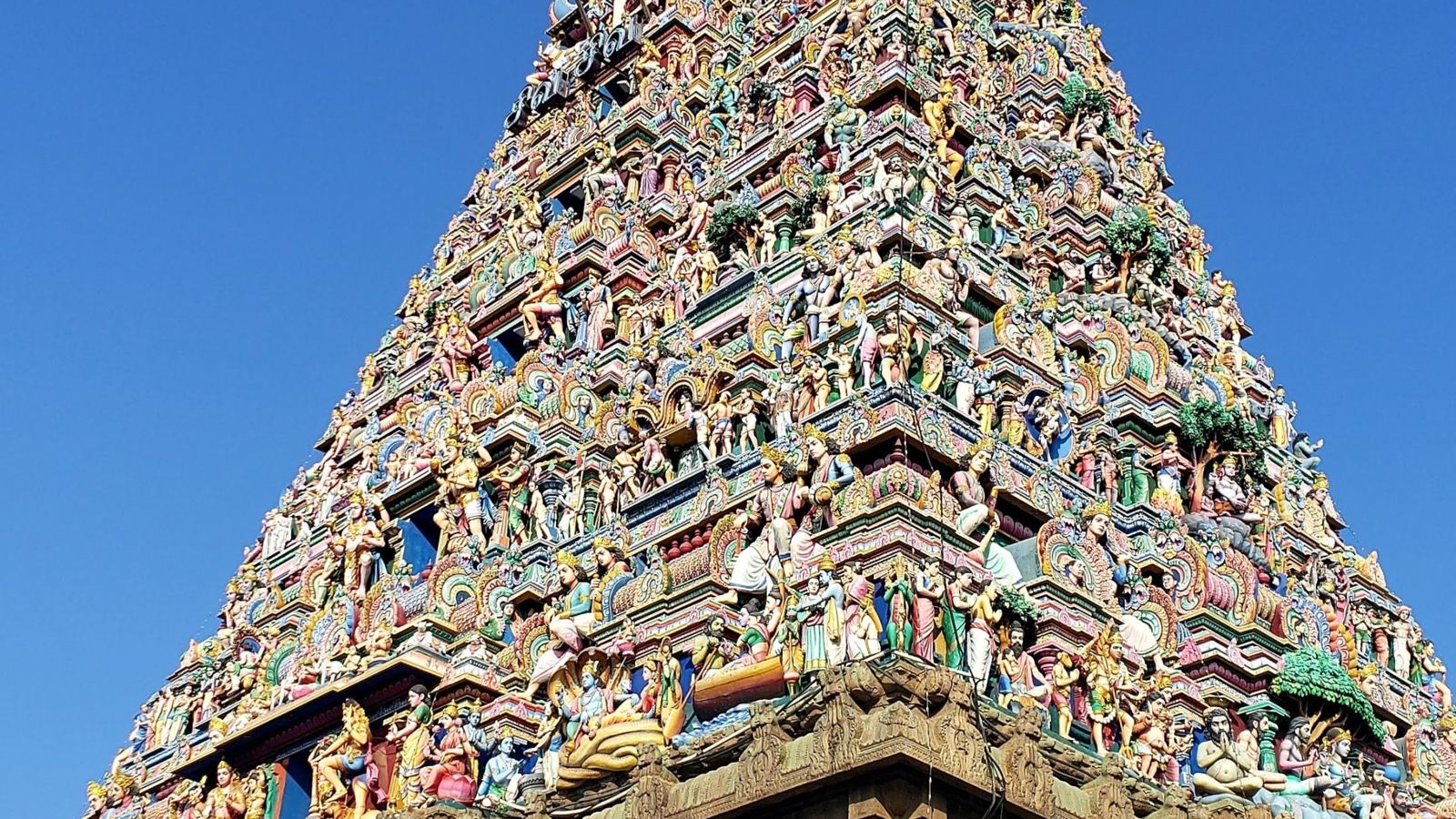
Arrived in Chennai, a city of 8 million and capital of the state of Tamil Nadu. Hindu devotees at a 16th century temple that seems part Disneyland, part ancient sacred turf.
St Thomas Cathedral in Chennai is exceptional for two reasons; first it is sparkling white, a rare thing in India and second, it is one of only three churches in the world that claims to hold the relics of one of Jesus's original apostles. St. Thomas travelled to India by boat, crossed the continent on foot and was assassinated by Tamil natives in 72 AD. India was a crossroads of cultures in a time when travel wasn't easy. No Google maps, no wi-fi, no bottled water!
Like every other place of worship we have seen here, the interior was embellished with flowers, twinkling altar lights and richly brocaded banners. More is better in India! @ Chennai, India
Pondicherry, a former French territory on India's southern east coast, established in the 16th century, lies a few hours south of Chennai. At its center there is a small seaside neighborhood replete with European architecture and tree-lined streets that hints at the paradise that India could be. Dragon flame trees and bougainvillea explode against the blue curtain of a cloudless sky. The streets are relatively quiet. The sea pounds against a breakwater that runs along the coast road. Parks and white washed government buildings with neat garden layouts speak of gentler times.
But like the rest of India, wear and tear has taken its toll. The edges are fraying. The creep of poverty is gnawing on its bones. I wonder how long it can hold out, before it succumbs. Or maybe, India will rise again to its former glory. We are rooting for her!
@ Pondicherry
In Europe it's churches. In Egypt, it's mosques. In India, it's temples! A few observations:
Hindu's pay tribute to a million different gods. As if that's not enough divine inspiration, some gods have several incarnations, most have multiple names and each has an assigned animal or two which serves as his or her vehicle.
Apparently, they feel the animal kingdom is lacking in some way. In addition to bulls, tigers and mice they have assembled new ones to star in their mythological stories. Their mix 'n match approach has culminated in a Lego zoo of flying monkeys, men with animal heads, lion, peacock, elephant, alligator combinations and more.
To play "WHAT'S MY LINE?" with Hindu gods you also need to know the symbolic items they hold in their hands, the weapons they carry, the postures they take, their hairstyles, headdresses and a myriad of other details.
The legends that gave rise to these gods are meandering fantasies that seem to have been generated in an altered mind state. Hallucinatory drugs or meditation or both!
I have yet to be able to link the gods and myths to any overarching rational belief system. It's kind of a "throw it all in the mix master, pray for the good stuff and think positive" philosophy blended with idol worship. Statues get washed, decorated, polished and fed, sometimes two or three times a day.
Despite this rather flexible and generally accepting belief system, there are a host of rules and rituals governing temple etiquette. Shoes off, shoulders covered, no worship of broken statues. No pictures can be taken in the inner vestibule. Coconuts get smashed, flowers hung, oil lamps lit and fruit offered.
To keep you on your toes, there is a packed festival schedule. Expect to see elephant's processions, with floats and costumed revelers dousing friends in colored powder, engaging in water fights and taking part in singing and dancing rituals.
Temples are everywhere. Carved from rocks. In caves. On mountaintops. In central squares on city grids. In villages. Along roadsides. In fields. In the south the carved stucco temples rise up in rainbow sherbert colored splendor. This variety is high maintenance, needing fresh paint every 5 years.
There are usually several temples, including the main temple for the chosen god. Then there are a multitude of mini temples for the wives, children and other friends and relatives of the key god. It's sort of a "family of gods" approach to worship. This probably insures at least one of the gods is listening to your prayers.
Inside the labyrinth of a temple complex you will likely encounter live elephants, cows, cats, dogs and monkeys. Some are sacred, others just sharing space.
You can also find wish threads, water wells, flags and incense.
Yesterday I witnessed a priest buckling a silver suit of armour onto a granite statue of a bull. I don't know where they keep these special decorations or why they drag them out, but it definitely ratchets up the "kitsch" quotient.
I also got an elephant blessing yesterday. A 10 rupee note offered to the gentle giant gets you a tap of his trunk on your bowed head After he snatches up the money and deposits in the collection box. Catholics should take note. It's definitely more effective than passing a plate down a pew!
Lastly, let's not forget to mention the scantily clad (actually shirtless) Hindu priests wearing colored stripes of ash on their foreheads. It's made from cow dung. To be crass and a tad disrespectful, but only for the sake of the pun, "You can't make this shit up!"
The world is full of surprises. Not far from Pondicherry, is a place called Auroville. You have to navigate about 10 miles of country road to get there...not the kind of charming country roads you might be picturing...the kind that are edged in desperate poverty and full of red clay dust. Jaw dropping poverty, punctuated by the occasional guest house or quirky restaurant. Upon arrival you are welcomed into a village that has the distinction of being funded by UNESCO as a social experiment promoting human unity. The brainchild of Sri Aurobindo and his wife, affectionately called MOTHER,
it appears to have started out with a bang, but having just passed its 50th anniversary is now sputtering along. Its mission is inspiring. But the cult-like adoration of its founders is a bit spooky. Made for a very interesting morning!
A salute to the entrepreneurial spirit of India. Antique and rusting equipment be damned. No stall to sell goods? No matter. Just spread a blanket. No blanket, just plop down in the dirt.
@ Pondicherry
We made a two-hour journey north to arrive in Mamallapuram, a Pallava dynasty temple site on the shores of the Indian Ocean. Along the way, the rice plantations and salt fields stretched into the distance.
Mahogany-skinned turbaned laborers raked salt under the heat of the tropical sun, while women in their candy colored saris planted and harvested rice. If they are lucky, they make $2.00 per day.
@ Kalpakkam
A world apart.
A world unto itself.
Farewell To Pondicherry. It was certainly an experience! A reminder that beauty is not lasting, and that maintenance is expensive.
Another UNESCO World Heritage site, near the village of Mamallapuram, where the 6th century Pallava dynasty kings left their mark at the harbor where ships docked to trade Indian spices and silks. The Hindu gods are lucky. They get to hang out in all the best places!
Who could've imagined that we could have a NATIONAL GEOGRAPHIC moment strolling down a Tamil Nadu village street on a Tuesday afternoon?
As we were returning to our hotel, we spotted a few cows up ahead. (The entire expedition is also noteworthy, but for now, we'll just focus on the cows.) Thinking this was a Kodak moment, I encouraged Nabil to run ahead to meet the threesome and then continue walking towards me with the cows in tow.
Of course, always eager to showcase "the thumb", he eagerly obliged. The first click went off without a hitch. The second too. Then, without warning, the white cow whipped around and came right at him. The coconut salesman gestured wildly and called out in warning. Nabil turned to face the cow, let out a shout, and though she was only inches away, she retreated. I started laughing. Hard! Then the beast decided I was easier game, lowered her head and began her charge towards me. "The Thumb" shouted, waved his arms and jogged toward me. It was enough to spook her. She trotted over to the calf she had been protecting, but which we hadn't seen, nuzzled her a bit and that was that!
Well, not exactly. There was a bit of finger pointing and laying blame as Nabil and I tried to sort out who was negligent and who could have done more to keep who safe. Guess who lost that battle?
Check out how these banyan tree roots have grown around this local temple.
We've been staying at a lovely seaside resort for the past two days. Among the many special touches; butter sculptures decorating the lunch buffet spread, an infinity pool that seems to spill into the Indian Ocean, massive bougainvillea in full bloom, tropical gardens featuring modern and tribal sculptures, a second swimming pool that meanders through the center of the property, embarrassingly attentive service and a spa. So why on earth did we venture into the local village today? Stay tuned....
Kailasanathar Temple sits on a few grassy city blocks in Kanchi. Its sandstone lion-faced pillars fiercely guard the worship halls. Painted sculptures adorn 58 small chapel-like structures facing the interior court. Built by the Pallava Dynasty, it's still that for a king!
Before we left Kanchipuram yesterday, we stopped at a weaver's collective; a community of 850 families who work with and for government sponsored textile shops. We met Manju and his family. At 73, he toils away for 12 hours a day on a 250-year-old wooden loom that's been in his family for 10 generations. The wood is dry and brittle, the strings frayed with age. The clacking of the shuttle and foot pedals is ever present.
Manju's workshop is also his bedroom, laundry and living room. Here, he spins raw silk into beautiful saris. It takes 25 days to produce one sari. He makes about $3 a day. The saris will sell for $300 and up. Some will be priced in the thousands. He will be paid the same regardless of the quality of the piece spun on his loom.
Three generations live in this three room house. Seven people are crammed into a low ceilinged windowless cement home with a piece of fabric for a front door. Two toddlers sit with their grandmother on a straw mat next to the loom. One is bare-bottomed. A few plastic toys are piled in a corner.
A hand powered pump provides city water to residents, but it is only available for three hours every other morning. Electricity is also sparingly metered. Manju's most prized possession; a lopsided washing machine which takes center stage in the living room. It's an older model, full of dust and hand prints. The morning's laundry hangs to dry on a clothesline stretched down the alley.
These proud, skilled, hardworking people will never know the bounty of the life we enjoy In America. From dawn to dusk they ply their trade and do so without complaint. India is humbling. It is a constant reminder that life is not fair, but life goes on.
@ Kanchipuram, Tamil Nadu
A very long day to the last stop in India!
Sometimes I think we are crazy. Yesterday we clocked 6 hours roundtrip by car to travel to the southernmost point in India.
We've now been to several of these milestone points around the globe, including Key West in the USA and the Cape of Good Hope in South Africa and Cape Horn In South America.
To add insult to injury, we drove another 90 minutes to visit Padmanabhaswamy Temple, reported to have a treasury valued at $170 billion, making it the worlds wealthiest place of worship. While we survived the trip, as non-Hindus we were not allowed to enter, so had to make do with a walk around the perimeter.
After almost 9 hours of car transport our travel map has three more pins and our backsides a few more aches and pains. Don't you think we are crazy?
Bodies. Biceps. Beefcake. Blondes. In that order. While we wander around India ogling its treasures, most of India is ogling us. It seems that buff men are in short supply, so "the thumb" is creating quite a stir. We are constantly assaulted by people asking for photos with him. As we stroll along, men, women, boys, girls, old men, old women, police, hotel and wait staff, shopkeepers, families, other tourists, guides and priests cast furtive eyes as we pass. Then they give me a characteristic Indian head bob akin to a thumbs up. "Nice body, good muscles, healthy body, big muscles, good man." These conspiratorial comments are shared with me as if somehow I might be unaware of his hulking mass and its mesmerizing impact on the locals. The unspoken message is that I should surely keep him close, for fear that some other woman will spirit him off. (As if some other woman could handle this Prima Donna!)
At times, the demand for photos has been so extreme that our guide has had to intervene and put a stop to the requests so we could keep pace with our itinerary. Some folks have asked for autographs. Occasionally a line forms. Some have insisted that Nabil is a famous Hollywood star or UFC fighter traveling incognito. Of course, he runs with that!
Every so often, I am pulled into the frame. My blonde hair earns a few compliments, especially from the women. But mostly I am invited in as an afterthought. It's a polite way to correct the imbalance in adoration given to "the thumb." No respectable Indian would ignore the needs of all of his or her guests, so I am recognized by default. I am ok with that. Fame takes its toll, but as you can see, the "thumb" never tires.
My photo library is full of smiling strangers. Nabil's thumb is in countless more. I often wonder what stories they will spin when they share their pictures of themselves with this swaggering American. One young woman approached from behind and tapped Nabil's shoulder. Startled, he spun and with his still lightning quick reflexes, nearly landed a karate chop to her face. I know what story she will tell!
Grab a cup of tea. I'll walk you through another beautiful place, so you can savor your tea with a deeper appreciation of how it arrived to your table.
A 4-hour drive north and east from Cochin lies Munnar, the place of three rivers. It is an Indian hill station. Here, the British discovered that the sloping hills, and the warm days and cool nights are ideal for the cultivation of tea. It's also perfect for flowers! They don't bloom here. They explode in huge bouquets of sumptuous color.
But it is tea that blankets the hills in an undulating jigsaw puzzle formation. Neatly cropped, the tea plants are thick with deep green leaves, and long exposed roots snaking through layers of deep rich soil. The smaller brighter green leaves signal the trees that are ready for harvest. Slender silver oaks dot the hills, providing shade for the laborers. They also protect against soil erosion and drought.
The fields are worked by families who rise with the sun and work until dusk, pruning, planting, fertilizing, harvesting and processing tea. They work through the heat of searing summers and in the "summer with winter season", when snow lightly dusts the fields in the morning before melting as midday temperatures climb into the 80's. Then the rains come, and they come in spades for four long months. With small umbrella hats and plastic ponchos, the plantation workers grind on during the monsoons. They brave leeches, snakes, rodents and insects. Cuts, rashes, and exposure to pesticides and fertilizers are also job hazards.
For this, they earn $3.50 per day. They are expected to pick 32 kilos of tea leaves each day. They get 2 extra rupees for each kilo above their quota. The current exchange rate is 70 rupees to a dollar. I can't imagine how many tea leaves are in a kilo, but it has to be a huge amount. Each leaf is about the size of a mint leaf. That works out to fractions of a penny for any extra effort.
Nearly 50% of the people living in Munnar work for the tea plantations. Of course, there are plummier jobs; staff, supervisor, factory worker. But most are tenant farmers.
Housing, electricity and water are debited from their pay. The cement row homes with tin roofs resemble stalls rather than a place to raise a family. The houses have no heat or running water. Most people cook on wood stoves. Hot water is made on a fire. You can see the smoke rising from the chimneys that are scattered in the fields and smell the smoldering eucalyptus wood.
There are a few government concessions for the lowest paid workers. Some companies provide free childcare, medical services and education...but it's not like your neighborhood nursery school or hospital. Life here is hard. The lifestyle, primitive. Convenience isn't a consideration.
So as your tea steeps, scroll through these pictures, marvel at the beauty and then take a minute to appreciate the many invisible lives who labor to sustain and nourish you. The seeds of the simple pleasure of your cup of tea may have sprouted in Munnar.
Spent three hours bouncing on monsoon rutted roads while on a jeep safari in the forested hills in Munnar. We played Indian Jones for a day and have the bruises to prove it. I guess it's time to get back to the gym.
From quirky worship sites to hanging bridges it was a smorgasbord of sights to savor. We passed many small private farms growing black pepper, tea, coffee and jackfruit in the dense jungle. The homes ranged from McMansions to huts. Like everything else in India, the diversity is startling.
On our way to Cochin we stopped to get some fresh coconut water...the real deal! The quality control supervisors looking the other way! @ Cheeyappara Waterfalls
An early morning walk along the bulkhead of Fort Cochin was a pungent mix of fishermen, their catch, and the general disarray that is India. Nowhere else does high tech modern living integrate so seamlessly with age old traditions. And nowhere else will you find beauty and repugnance so frequently commingled.
Eye-popping! Over the last month. We have borne witness to the plight of over-population, illiteracy and poverty on a massive scale. It brings into sharp focus the need for environmental regulation and improved education across the globe.
The broad sandy beaches that encircle the Bay of Bengal could be Chennai's crown jewel. Instead the waters are a fetid coastal fermentation tank. The beaches are cluttered with tents, fishing nets and garbage. The stench is overwhelming. You want to shield your eyes from the blight of the lopsided slum buildings stacked along the coast road, but the conditions are so extreme that you are drawn to it. It has to be seen to be understood, to be believed.
The slums of Mumbai, the villages near Hampi, the seafront in Kerala...the countless towns and small cities across South India all suffer the same burden.
It would be easy to pass judgement. Easier still to refuse to look closely. It is nice to live in a bubble, to believe we are not like them. We can tell ourselves we have worked hard. We deserve nice things. We don't need to suffer or be uncomfortable. It is our reward. Don't be fooled. These people also work hard. Few will ever be rewarded. Life is not fair.
We are enjoying 5-star luxury accommodations as I pen this post. Every convenience is at our fingertips. Window blinds, lighting, room temperature and television are controlled by an iiPad touch screen. A few steps away, there are people sleeping on the cement. Their odds of climbing out of the muck are near to impossible.
We cannot escape responsibility for being good stewards of the earth we inhabit. We need to be concerned neighbors. Our planet is groaning under the weight of supporting the billions of people living in third world conditions. The damage cannot be contained by borders. We should all care, because the future of clean water, clean air and clean living is at stake.