We launched our 50th anniversary trip to Tunisia a few days ago. After a 16 hour slog through three airports, we landed in Tunis!
We're traveling with a small group tour, and are among the youngest of the 16 travelers who ventured to this small north African country.
It's inspiring to see couples in their eighties still trekking around the world and planning future adventures. Many on this trip have logged more trips than we have, and despite their age, are keeping pace. climbing ruins and battling the weather. One guy has done 147 countries and several have checked off many of my bucket list trips that I've yet to do. So while this adventure promises to be another sensory feast, I'm already mapping out the rest of the year!
Tunis is the capital city of this tiny country that hugs the Mediterranean Sea. It has the bones of a once beautiful lady, but has been ravaged by time and worn out by life. The French occupied it for many years and their influence can be seen in the graceful city center buildings adorned with lacework iron balconies, and ornate sculpted doorways.
Sadly the Arab Spring which promised so much, delivered nothing. Once a thriving tourist destination for Europeans, it is now on life support. The shops in the medina are poorly stocked or shuttered. Everything needs a fresh coat of paint. The streets are littered and the sidewalks are crumbling. Once grand buildings stand vacant.
Still, there is much to enjoy, and thankfully our tour guide is fabulous. Mohamed has pulled back the curtain on the secret treasures of a country that hasn't discovered its own value.
We've traveled with Overseas Adventure Travel before and what makes it special are the many ways they try to weave cultural experiences into the itinerary. Two days ago, we visited a small family farm that has been revitalized by a former mechanical engineer who had a vision for renewing his family farm. In just a few years, he's transformed a barren plot of land into a buzzing paradise that feeds sixty families with organic produce, eggs, olive oil, honey and chickens. He enthusiastically demonstrated how he's rebuilt the soil, rotated his fields, employed the animals to fertilize his crops and reduced his dependence on rainwater. His infectious passion for this project was a joy to behold. After our field experience, we had a quick cooking lesson, topped off by a farm-to-table lunch that was scrumptious. Sadly, a few of the free range chickens we had just admired were in the stew pot.
Dougga is one of North Africa's best preserved archeological sites...and has been continuously inhabited for over 2000 years by the Berbers, Roman's and Carthegenians. We went there on a cold, rainy and windy day, after a brief stop in Testour, where we sampled freshly baked bread and a half dozen variety of cheeses. The calories helped brace us against the weather which was miserable. However, the scenic location and well preserved city served up its history on a silver platter.
Afterwards, we enjoyed a lunch of roasted wild boar! I'm not sure how long the tradition of boar hunting dates back, but I can see why its still a sport! Absolutely delicious! We've been eating our way through Tunisia....and thoroughly enjoying it!
Six hours by bus from Tunis is an island in Tunisia's Gulf of Gabès. Djerba is North Africa's largest island, recognized as a UNESCO World Heritage site for its unique, traditional settlements. Known for stunning, shallow, white-sand beaches, whitewashed Berber villages, and a rich, diverse culture, Djerba features major attractions like the ancient El Ghriba synagogue, vibrant markets in Houmt Souk, and the Djerbahood street art project. Best of all it is warm and sunny....a welcome change after miserable weather in Tunis.
We left at sunset, via the Roman causeway, originally built 2000 years ago, capturing pink flamingos feeding in the shallows at sunset.
Back in Tunis, we spent a half day at the national Bardo Museum, a jewel of Tunisian heritage. It is housed in an old Beylic palace dating back to the XIXth Century. It retraces, a big part of Tunisia’s history and contains the largest collection of mosaics in the world including the famous mosaic representing Virgil, the poet.
It is one of the most important museums in the Mediterranean region and the second largest museum in Africa after the Egyptian Museum of Cairo. The museum collection of Roman mosaics is thanks to excavations in various archaeological sites throughout the country including Carthage, Hadrumetum, Dougga and Utica.
The building itself is a piece of art, and while we saw a lot of exhibits, we barely scratched the surface. It is truly an under appreciated asset of an under appreciated country.
After leaving the island of Djerba, we traveled south through the rock desert. An ink black sky descended and wrapped our bus in darkness as we trundled through mile after mile of desolation. Eventually we arrived at Ksar Ouled Debbab. This once abandoned Berber storage facility, designed to house the grains and vegetables for the Amazir desert tribes, has been transformed into a boutique hotel.
In the dim light of a low ceilinged restaurant warmed by charcoal fired stoved, we ate a delicious five course meal of traditional Tunisian foods, before retiring to our rooms. No television, no wi-fi. Just the haunting isolation of this remote outpost.
In our rooms, outfitted with Berber textiles, and handcrafted wooden furniture, we spent the night huddled under a stack of blankets listening to the howling desert winds. Not your average hotel experience. But not much about this trip has been average!
Well after staying at the transformed Ksar Ouled Dabbad, I thought we had reached our quota of unique experiences. However, the next day, we headed out to visit two additional Ksars...one was the site of one of the Star Wars films and the second was another that was in the process of being refurbished. But the real highlight of the day was our trip to Cheninni, a semi-abandoned Berber village in the arid, rocky mountains. Somehow, halfway up the mountain, someone figured out how to fashion a restaraunt out of the rubble. Tucked into a cave-like room, with white washed walls, and rough hewn tables dressed in Berber cloths, we feasted on a four course meal that was superb.
Its hard to imagine anyone scratching out a living in this land of extremes...but thousands of people do. I'm feeling grateful that I don’t have to, but appreciative for the chance to witness it!
Gobsmacked again! Traveled for hours through the rock desert, a hostile, barren landscape that seemed inhospitable to community life. But you'd be wrong to assume that. We stopped on a mountain bypass to check out the age-old tradition of processing olive oil locally. Just as an aside, there are 75 million olive trees in Tunisia, most privately owned. A local entrpreneurial family collects the harvest from different farmers and stores them in marked bins. His donkey, commandeered by his 10 year old son, powers a mill stone that grinds the olives in small batches corresponding to the numbered bins. The crushed olives are then pressed by a machine powered by muscle, not electric The oil is collected in plastic jars and then finally returned to the farmers as olive oil. The farmers pay for the processing in cash or by leaving a few jugs of oil with the processor, who can either use it or resell it. And that's how olive oil goes from farm to table in this scrappy community. Its local, organic and delicious.
After this little demo, we went on to the site of the original Star Wars movie, which was a troglodyte house before it was a movie set. These unique cave-like homes are dug into the ground. They feature an open air reception area, and then small rooms (living and dining areas, bedrooms, washrooms) are tunneled out of the rock. As a movie set, it was interesting, but as a private home, a troglodyte home is fascinating. We drove to a community of these underground homes to enjoy a home hosted lunch. Just touring the house was a treat, but to eat with the owners, to see how they prepare their meals, cook their foods and live in their homes was quite the experience. And lunch, which was vegan, was delicious.
From there, we moved on to the desert camp, but that's its own story, so ‘til tomorrow my friends.
Tunisia is a unique travel experience that has offered many jaw-dropping experiences!
Yesterday, we arrived at the outskirts of Douz, loaded ourselves into a caravan of 4x4s and drove for 90 minutes deep into the Sahara desert to our camp site. We came upon a small group of camels, including a few month old babies. They appeared to be wild, but we learned that they were branded, and at a price of 5,000 dinars you'd be wise to avoid messing with anyone's camels.
At the camp, we were treated to a cooking demonstration ... .bread kneaded into the shape of a pizza, then cooked in the ashes of a palm wood fire. Dinner was lamb and vegetables sealed in a clay pot, buried in the sand, and cooked for hours in a smoldering fire at the bottom of the sealed sand pit. It's like a Tunisian crock pot in the desert! While it cooked, we were serenaded by our desert guides as we sat around a fire under the stars. Served over couscous, with that fire charred bread and lentil soup, it was a memorable Sahara feast. We are certainly making memories….they're not serving this up in the low country.
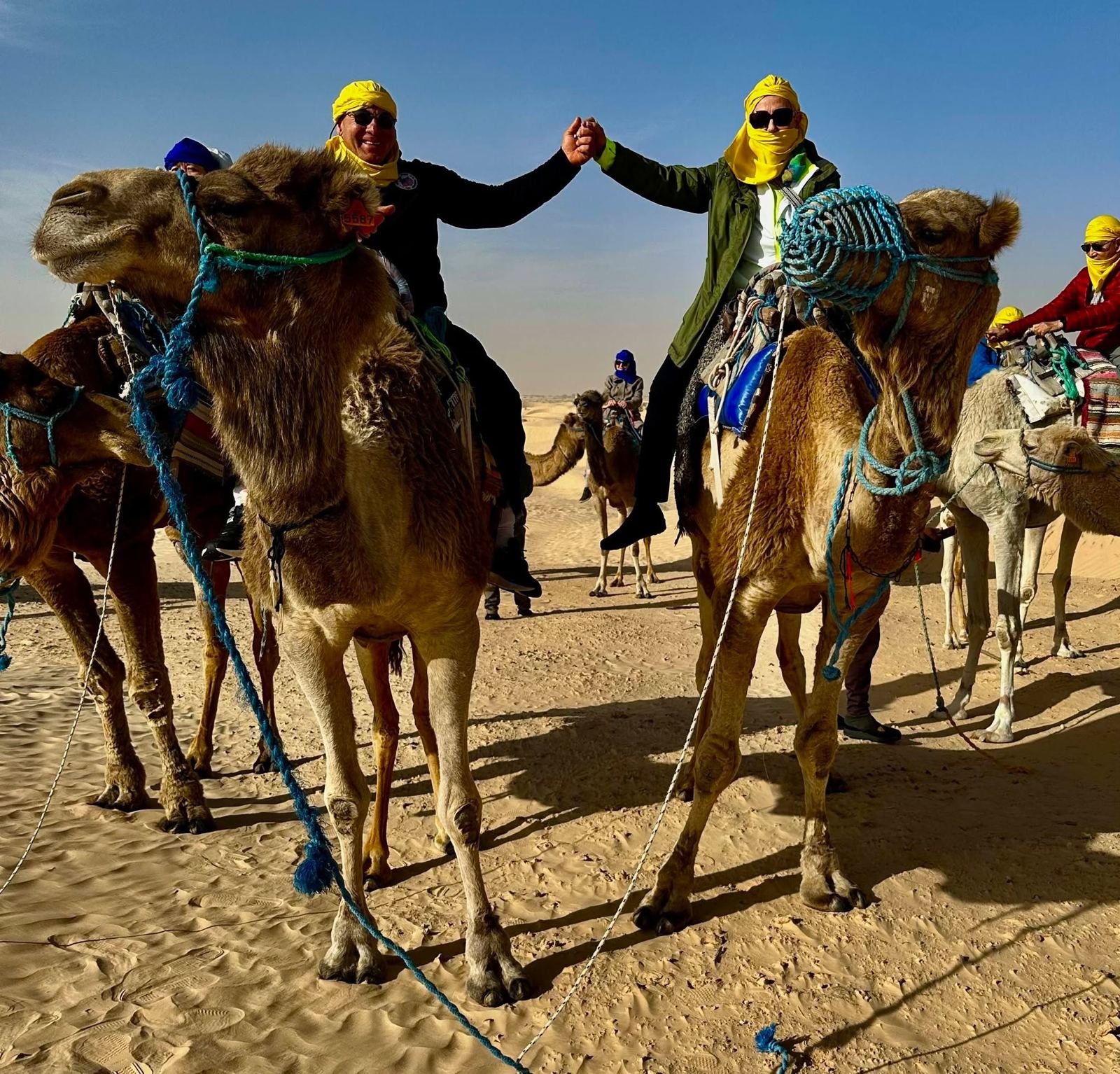
After our desert slumber, we piled back into our jeeps and zigzagged through the dunes to a remote outpost where our camels waited. Trudging across the sands in our Crayola colored turbans atop our awkward, stinky dromedaries, we looked every bit like the white-knuckled American tourists we were. I'm not sure everyone appreciated the ride, but I felt like an extra in Lawrence of Arabia!
Our final destination was Tozeur, a small city in the oasis at the end of an hours long bus ride through a huge salt lake that flattened out for miles. For as far as the eye could see, we were surrounded by a desolate sea floor in shades of gray and white, which is where road salt is mined for use in Northern Europe.
On arrival in Tozeur, we checked into our tree house hotel in the middle of a date palm forest. Since more than 40% of Tunisia is desert, the greenery of Tozeur's date plantations was a welcome sight. We stayed for 2 days, learning about date cultivation and the ancient art of brick-making and visiting a few museums. Unfortunately, we arrived at the same time the Western Sahara winds blew through town at about 45 miles per hour. It made it impossible to walk through the market, tour the medina or admire the unique brick architecture of Tozeur, a style mandated by the government. There hasn't been a lot of architectural beauty to admire in the small towns and villages of Southern Tunisia, so the veil of thick sand that obscured the face of Tozeur was especially frustrating.
Much like our other hotels, Diar Abou Habibi was not your run-of-the-mill accommodation. It's aesthetic saved us from the gritty monotony of our dust-cloaked surroundings. In Tunisia, beautiful scenery is not as bountiful as in other countries we've visited, but when you stumble onto something of merit, you are particularly grateful. You certainly take nothing for granted here!
Up at the crack of dawn and back on the bus. When will they introduce teleporting to traveling abroad? Not in my lifetime I guess! We headed out of Tozeur as the sun warmed the desert air. Clear blue skies replaced the curtain of dust that shrouded the city just 12 hours earlier. An unremarkable coffee stop preceded a second way point at a modern olive oil factory. Don't be deceived. Not all of Tunisia is primitive. Modern and mechanized production has replaced the donkey and the barter system in most places. It's obviously more efficient, but doesn't photograph nearly as well.
We drove another 2 hours before reaching Sbietla, a UNESCO site 2 hours south of Kairouan, our final destination. We ate a quick lunch before heading to one of the best preserved Roman archeological sites in North Africa, originally named Sufeleta, but more commonly referred to as Sbietla, which is also the name of the nearby modern city.
The sprawling city ruin was established in the first century AD. While only partially excavated, it is an excellent example of Roman urban planning and creativity. Originally established as a city for retired veterans of the Roman army, it became increasingly prosperous over the next 200 years thanks to the bountiful olive orchards surrounding the nearby area.
On site, we visited an olive oil press (way more primitive than either the donkey or the modern plant), the Forum, the Temples of Jupiter, Minerva and Juno, the baths, and the theater. While it was a bit windy (again), the brilliant blue sky and Mediterranean sun made for ideal walking conditions, and great photos.
After about 90 minutes we were herded back onto the bus, and made our way to the spiritual capital of Tunisia. The drive exposed the poverty of Tunisia along with the plastic pollution that plagues the country. On either side of the highway, blue plastic bags snagged by the prickly pear cactus fences marking property boundaries fluttered in the wind. Makeshift stores selling produce, olive oil, and car parts leaned into the wind. Despite thousands of olive groves, the scenery was bleak. For many here, life is grim. Between locations that highlight the unique beauty and history of Tunisia, lies another version of this third world country struggling to throw off the shackles of poverty.
The Kairouan medina on a sunny day gave us a chance to observe the local people engaged in their daily routines. A bit further along, but still within the walls of the old city, we encountered the souk, where almost anything can be purchased.
The best part of travel is the ability to awaken your senses to foreign sights, smells and sounds. In the North African countries, the old medinas are where you find them!
To really see a country is to commit to being slightly uncomfortable. Yes, you can time the breaks, interrupt the schedule with a fantastic tourist attraction or a great meal, but you still have to put in the mileage. It felt like the trip to Kairouan took forever. After 12 days on the road that's to be expected.
The historical Kasbah Hotel was once a fort and a jail within the old city walls. The yellow sandstone walls still soar 5 stories high. Beyond the glass doors of the lobby, a cerulean blue pool shimmered like an oasis. Palm trees stood like sentinels around the pool perimeter. They were wrapped in bougainvillea that reached to the third floor windows, sheltering hundreds of starlings who were returning to their hideout as the sun sank behind the courtyard walls. Their chaotic birdsong and fluttering energy greeted us as we stumbled off the bus, and it immediately pardoned the insult of our day-long journey!
The following day we stayed put and thank god! All that this Unesco Heritage city offered was within easy walking distance.
An ancient cemetery butted up against the outer wall of the hotel, the gleaming white headstones bleached whiter by the morning sun and curiously missing any engravings. Before the population explosion and during the years when families never ventured far from their roots everyone knew where their ancestors and their secrets were buried. There was no need for labeling the burial site!
Another highlight included the Great Mosque of Kairouan, built in the 7th century. At 97,000 square feet it is one of the largest mosques in North Africa. Its many columns surrounding the outer courtyard were confiscated from Roman homes and temples, and a careful inspection reveals their varied heights, widths and construction materials. Its design was a model for all the mosques in the Mahgreb (western Africa) that were subsequently built. It is considered a holy place by Muslims and many consider a pilgrimage here to be a substitute for the Haj.
A mile or so away is the Mausoleum of Sidi Sahabi, a companion of the Prophet. Supposedly his bones were found hundreds of years after his death, and boxed up and buried here. Beautifully tiled, with carved ceilings and a courtyard surrounded by arches and columns, it is far more pleasing to look at than the Great Mosque. It too is revered by Muslims.
The monuments, the medina, and the souk, allowed us to step back in time…and to take a bus break as well!
Of course, we started the day with another bus ride! This one, however, was only an hour or so long. There wasn't much to see on the way, until we passed a pole and tent butcher shop next to a small herd of camels. It took me a minute to make the connection. I think it was the severed camel head hanging in the center of the displayed carcasses that gave it away….camel meat for sale! Logical, but not appealin and thankfully we didnt stop.
Our destination was El Jem, the site of the 3rd largest Roman Coliseum in the world with a capacity of 35,000 spectators. Partially destroyed in WW II, it still inspires awe. The Romans certainly left their mark in this tiny country. We've seen our fair share of these ancient stadiums as we've traveled through the Mediterranean, but we've never been able to go into underground areas where the lions, tigers and other fighting animals were caged. The niches for oil lamps to light the cavernous basement level, the canals for waste management, and skylights with multi-functional covers all demonstrated that the Romans certainly knew how to care for the stars of the show. Big cats, big smells…but they had it under control. A climb up to the top of the massive four story structure opened up an incredible view of the surroundings. It also helped us gain perspective as to the scale of the stadium itself. These forays into the life and times of other civilizations wriggle into your imagination stirring a feeling of connection to things lost to time. You feel the heartbeat of history with each step you take!
There's also a small museum nearby attached to a small field of partially excavated ruins. Apparently, this was the residential area of the city….but 1,800 years of successive inhabitants have reclaimed the land, recycling the architectural elements and building materials to fashion their own homes and villages. It would be prohibitively expensive to buy back their homes, even if they were amenable. Most of what survived the pillage has been laid to waste by wind, weeds and desert sand. The museum showcased the rest. It held an artful display of floor mosaics found nearby and painstakingly re-assembled for preservation. The most interesting display was a fully reconstructed Roman residence built around floor mosaics and other partial remains of a house found on site. Its amazing how these intricately crafted mosaic floors have survived intact for almost 20 centuries. And its also amazing to see the art embedded in them. Animals, gods and goddesses, sea creatures, foods, flowers, and mythological creatures are set in elaborate bordered designs that make today's hardwood floors seem flimsy and cheap!
Mosaics are everywhere in Tunisia. Inspired by the Roman's, the art has not been lost. We visited a workshop where women tediously crafted these design from tiny pieces of stone hand cut and carefully overlayed and glued on patterns that mimic those of ancient Rome. Of course, this was also a souvenir stop and our travel companions took full advantage. As we left the shop, picking our way over stacks of marble and discarded remnants of the manufacturing process, a litter of puppies hesitantly emerged to gawk at our rag-tag group. By day 13, we were spent, but puppies are the perfect antidote to fatigue! Thank god, because those Coliseum steps were waiting!
From Hammamet to Sidi Bou Said felt like a hop, skip and a jump compared to some of the long stretches we did in Tunisia. Much like Hammamet, it is a whitewashed village adorned in bright blues, however, Sidi Bou Said sits on a hill overlooking Tunis Bay, rather than at sea level. It is smaller than Santorini, not as pristine, nor are there as many unique stores where you can spend your tourist dollars, but the likeness is hard to ignore. We stayed in Dar Said, a lovely guest house with spacious rooms and fabulous views…though clouds and rain wiped it out from time to time. This was our last and well chosen stop, before leaving Tunisia.
Its proximity to Carthage, the Roman aqueduct, baths and cistern and the North African Cemetery for US soldiers were the icing on the cake…but that's for our final post!
One of the benefits of travel is discovering how little you really know about a certain subject. I'm not a history buff and the details of war, any war, are not my strong suit. So a visit to the North African American Memorial and Cemetery was not just a moving experience, but a wonderful way to learn about the strategic role that this area of the world, particularly Tunisia, played in World War II.
The bodies of thousands of US military men were once scattered across Morocco, Algeria, Tunisia, and Libya and Egypt in 16 temporary burial sites. They were eventually exhumed and moved here to be honored in this meticulously maintained memorial. In addition, the names of hundreds of soldiers whose remains were never recovered are etched on a memorial wall. Northern Africa was where the US staged its initial attacks in Europe, shipping supplies across the Sahara, and down and around the Cape and up through the Western coast of the continent through the Red Sea. It was here that Patton and Rommel faced off.
It was an unexpected and moving discovery, and a reminder how a unified effort against the forces of oppression rippled across the globe to secure our freedom and the freedom of so many.
A flurry of stops in Carthage punctuated the end of our Tunisia adventure. Today a modern town sits atop the Roman And Phoenician ruins where the Punic wars once raged.
The Romans did a number on the city of Carthage, purposely destroying it and then constructing their own city in its place. Now most of both civilizations has been lost to time. We saw a small Carthage site where funerary jars and stones were being excavated. Ironically, a few weeks prior a vicious storm partially destroyed what archeologists were painstakingly trying to salvage.
We also visited the remains of the largest Roman bath complex outside of Rome. The massive pillar that was partially reconstructed helped us visualize the height of the arched roof under which the residents and their slaves bathed.
A little farther afield, we went to see the remains of the massive cistern that fed the city fountains and the baths, the largest in all of the Empire, and a small section of the aqueduct that delivered the water to the city. A shepherd and his flock now inhabit the area, feeding on the trampled grass and weeds, probably oblivious to the deep history of the site.
It seemed a fitting conclusion to our tour, a place where the intermingled layers of history are partially obscured, and need to be teased out if we are to appreciate them. Tunisia is not a country that pounds its chest. Instead, it whispers its importance to those who are lucky enough to venture there. So glad we did!